.avif)
Thank you for your interest in the George Washington University’s College of Professional Studies. Please fill out the request for information form below, and we will be in touch shortly.
Coordinated Crisis Command: Interagency, Communication, and Workforce Leadership During CBRNE Incidents
Program Overview:
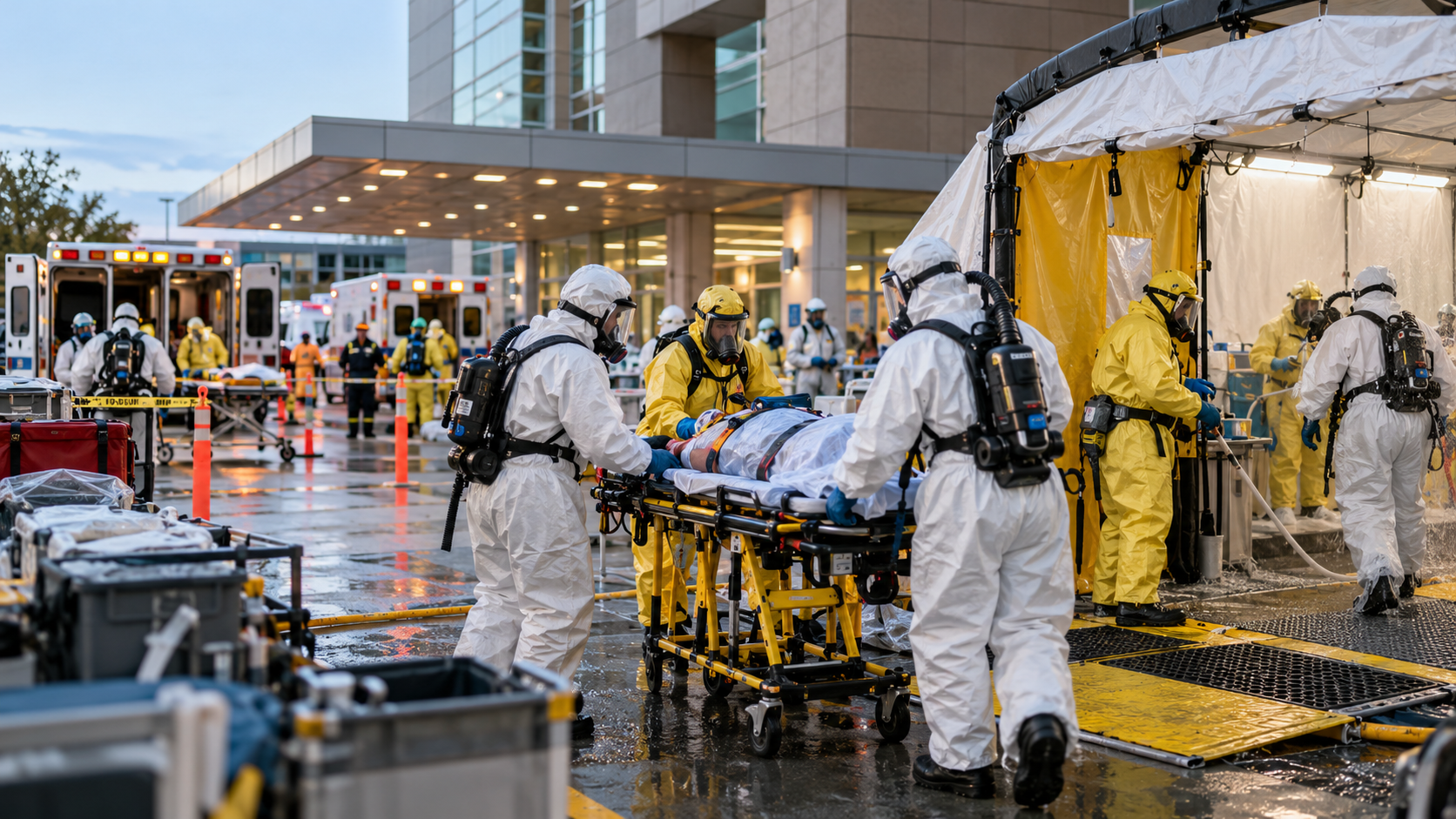
This micro-credential, delivered by George Washington University and the American Hospital Association, equips senior hospital leaders with the knowledge and decision frameworks needed to support interagency coordination, communication, and workforce protection during a hospital CBRNE incident. Over a focused 10-hour, fully online and self-paced curriculum, participants explore multi-agency coordination, MOU development, public and family communication, and staffing contingency planning through video lectures, interactive exercises, case studies, and scenario-based simulations. Downloadable tools and templates support future application within participants' own organizations after course completion.
Partner Organizations:

The George Washington University,
American Hospital Association
What the Course Covers:
Executive Roles in Multi-Agency Incident Command
Description:
This module establishes how hospital executives interface with law enforcement, fire and EMS, public health, and government agencies during a CBRNE incident, and examines frameworks for structuring command authority within the hospital and across partner organizations.
Subtopics:
- Overview of the Incident Command System (ICS) and hospital-specific adaptations (HICS)
- Executive liaison roles with law enforcement, fire/EMS, and public health agencies
- Establishing command authority and decision rights across organizations
- Common breakdowns in multi-agency coordination during past CBRNE events
- Downloadable interagency coordination framework for future organizational use
Memorandums of Understanding and Resource-Sharing Agreements
Description:
Explore the principles and processes used to establish, negotiate, and maintain memorandums of understanding (MOUs) with other hospitals, regional coalitions, and government agencies to support resource-sharing, mutual aid, and preparedness before a CBRNE incident occurs.
Subtopics:
- Core components of an effective hospital MOU for disaster resource-sharing
- Identifying priority partners: regional hospitals, healthcare coalitions, government agencies
- Approaches to negotiating and maintaining MOUs over time
- Activating MOUs and mutual aid agreements during an active incident
- Downloadable MOU evaluation and planning tools for future organizational use
Family Reunification, Media, and Public Information Command
Description:
Examine the executive's role in family reunification logistics, media coordination, and accurate public information during a CBRNE incident. Through examples and simulated scenarios, learners explore communication decisions made under conditions of uncertainty, confusion, misinformation, privacy concerns, and operational security.
Subtopics:
- Components of family reunification sites and protocols designed to reduce confusion and traffic
- Executive-level media relations and public information officer coordination
- Managing misinformation and rumor control during an active incident
- Balancing transparency, patient privacy, and operational security in public statements
- Downloadable crisis communication and family reunification tools for future organizational use
Staffing Contingency and Workforce Protection Strategy
Description:
Examine executive strategies for sustaining and protecting the hospital workforce during a CBRNE incident, including staffing contingency approaches, secondary contamination protections, and measures to address burnout and psychological strain among staff.
Subtopics:
- Components of staffing contingency plans for extended or multi-shift CBRNE response
- Administrative measures to reduce staff secondary contamination risk
- Recognizing and mitigating workforce burnout and psychological strain
- Volunteer management and credentialing during a surge
- Downloadable workforce contingency planning tools for future organizational use
Capstone Scenario and Coordinated Crisis Command Planning
Description:
This module integrates concepts from across the micro-credential through a self-paced simulation of a hospital-based CBRNE incident requiring simultaneous interagency coordination, public communication, and workforce management. Learners interpret scenario information, identify command gaps, prioritize potential actions, and make executive-level decisions within the simulated environment. A downloadable 90-day crisis command planning template is provided for learners who wish to adapt the course framework to their own organizations after completing the program.
Subtopics:
- Self-paced multi-agency and public communication scenario
- Identifying coordination, communication, and workforce gaps within the scenario
- Prioritizing executive actions based on scenario conditions
- Evaluating alternative courses of action and their potential consequences
- 90-day coordinated crisis command planning framework and downloadable template
- Course completion and self-assessment
Learning Outcomes and Skills:
Skills You'll Gain:
- Multi-agency incident command coordination
- MOU evaluation and resource-sharing strategy
- Crisis communication and public information command
- Workforce protection and staffing contingency planning
Pricing and Continuing Education:
$400
Group Enrollment for Your Team:

One-time Fee
$400
.png)
.png)
.png)

.png)
.png)
.avif)

.avif)
.avif)
.avif)
.avif)